I’ve been collecting Japanese woodblock prints for a few years now. Before I knew it I had collected quite a lot. Thirteen at last count.
Grab the Ghost of Yoshitoshi tee here
My initial interest was peaked by war scene triptychs, splayed out across 3 panels, full of action and detail where you could spend 20 minutes looking at a panel, and still find interesting new elements. Then I discovered the serenity of the single panels, scenes in sun-drenched autumn with orange leaves or saturating snowfall with isolated sleet-roofed huts and frigid waters, the kind that Bob Ross was clearly inspired by. And then … then I met Yoshitoshi… and nothing was ever the same again.
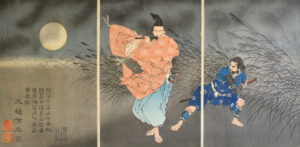
The first panel allows the entire scene to breathe. Normally a triptych is chaos, but Yoshitoshi allows the moon to represent the entire panel.
The middle panel is the flute-playing Fujiwara. Mesmerising, lost in his own music, delivering a tune that is captivating everything around him. We also see the foot of the bandit, entranced perhaps by the floating notes, unable to attack but unable to resist.
The final panel is the bandit, frozen in time in mid-draw of his sword. Seemingly stuck at an angle that shows retreat as well as attack. He’s almost surrendering to the sounds, wanting to rob Fujiwara, but at the same time being robbed by Fujiwara of his will to do so.
And then there’s the reeds. The only element that exists across all three panels bridging them together. They dance to Fujiwara’s tune, they move with his music, they are shaped by his song.
All of these elements, as well as the gorgeous colours popping against the gloomy midnight, are why it’s my favourite piece.
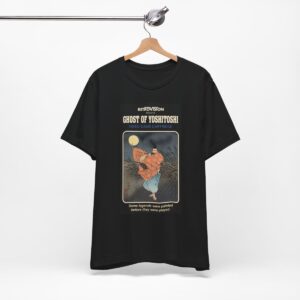
Owning the original is no mean feat. Authentic prints in good condition sell at auction for anywhere between $10,000 and $50,000. So I made a tee. It captures the essence, and now I can wear it. And so can you.
Grab the Ghost of Yoshitoshi tee here
Tsukioka Yoshitoshi (1839-1892) is widely regarded as the last great master of ukiyo-e woodblock printing. His career began at eleven as an apprentice to the legendary Utagawa Kuniyoshi. By his twenties he was making images of extraordinary violence, documenting a Japan tearing itself apart as the Tokugawa shogunate collapsed and the Meiji Restoration remade the country from the ground up. His series Twenty-Eight Famous Murders with Verse is exactly what it sounds like. He suffered a complete breakdown in 1872, rebuilt himself, changed his artist name to Taiso meaning “great resurrection,” and returned with new intensity and new ambition. By the end of his life he was fighting almost single-handedly to keep the woodblock tradition alive against photography and lithography. He lost that battle when he died in 1892, but not before completing, in 1883, what is indisputably his masterwork.
Fujiwara no Yasumasa Plays the Flute by Moonlight:
The scene draws from ancient setsuwa folk tales. Yasumasa, a Heian court noble, walks alone at night playing his flute. Behind him the bandit Hakamadare follows through the reeds, intent on robbery. But Yasumasa plays on, completely unbothered. Hakamadare, enchanted by the music, unable to attack, follows him home instead.

Dan
Latest posts by Dan (see all)
- Cyberpunk 2077 Mission: Clampdown Added by Patch 2.5 - October 22, 2026
- Cyberpunk 2077 Mission: I’ll Fly Away – Not Triggering - October 20, 2026
- Cyberpunk 2077 Mission: Ghost Town – Where’s My Widow Maker? - October 19, 2026